

What Is Foley Balloon Catheter?
For some people, the bladder fills but simply won’t empty, whether because of an enlarged prostate, a nerve problem, or the effects of anaesthesia or medication. The pressure builds and the discomfort grows. A thin, soft tube can drain the bladder safely is the Foley balloon catheter.
When any patient goes to any surgical treatment, They are unable to move also during the IV treatment body is supported with the IV Fluids & medicines to keep the body hydrate, meanwhile the kidney also does it job and the waste is then collected into the bladder & then bladder needs to get empty in order to prevent it from overfilling, and the medical staff needs to track exactly how much urine the body is making.
Here Foley balloon catheter comes into consideration , its a thin, soft tube which makes both possible without any effort from the patient. It allows the urine to drains from the bladder continuously, and a tiny balloon at the end or tip of the catheter keeps its position still & prevent from slipping out.
That application and reliability is why it is one of the most widely used medical disposables in hospitals, ICUs and home care around the world.
GSTC is one of the leading manufacturer & exporter of Foley Balloon Catheter & other urology devices across the Globe. It’s a sterile, disposable, flexible tube, which is inserted into the bladder through the urethra and urine is collected in a bag. It is named for Dr. Frederic Foley, the urologist who refined the balloon design.
This catheter contains three active elements.
- The first is the drainage channel which carries urine out of the body.
- The second is a small balloon channel with a valve.
- Third, the balloon itself .
It is filled with sterile water inside the bladder and holds the catheter in place at the neck of the bladder so it can not slip out .
How the GSTC Foley Balloon catheter is inserted?
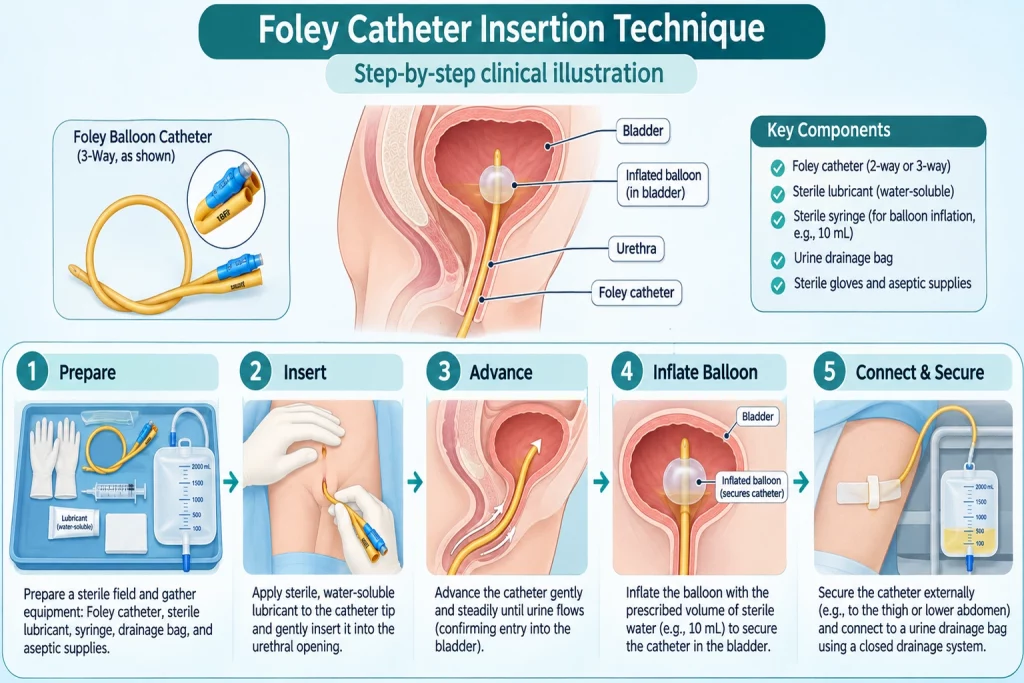
This is a task that should only be performed by a qualified healthcare professional; it should never be tried at home. After the area has been treated with an antiseptic, numbing gel or lubricant is applied to reduce discomfort.
The catheter is then carefully placed inside the bladder. The balloon is filled with sterile water as soon as the pee starts to flow.
In order to prevent urine from flowing back, the bag is placed below bladder level and the catheter is attached to a closed drainage system. here are the steps
- The genital area is cleaned with an antiseptic before insertion.
- Numbing gel or lubricant is used to ease discomfort.
- Catheter is then inserted through urethra into bladder.
- The retention balloon is filled with sterile water once in place to hold the catheter in place.
- Urine runs through a separate tube into a collection bag.
- Catheter remains attached to a closed drainage system for the duration of use
- Collection bag below bladder level to avoid back flow
What is Foley balloon catheter used for?
Whenever there is a need to measure urine or when it has to been drained, the most common reason is urinary retention, it’s a problem where the bladder is full but the patient can’t drain or empty it. The main cause for this is an enlarged prostate, or a blockage, or any condition related to nerve disorder.
The another big application of Foley balloon catheter is surgery. The bladder needs rest after any of the surgery bladder, prostate, gynecological, spinal or abdominal procedures. A Foley Balloon catheter helps the bladder for this.
In the ICU this is even more important as every ml of urine is measured to assess kidney function and fluid balance.
It is also used to keep patients on bedrest to maintain cleanliness and dryness, to remove the clots out of the bladder and to increase comfort in patient care.
- Urinary retention due to prostate enlargement
- Renal function tests – to accurately measure urine output in hospitals or home care setting.
- Recovery After surgery
- Prolonged immobilisation
- Intensive Care Monitoring
- The third channel on a 3-way catheter is used for continuous bladder irrigation, or flushing the bladder with sterile saline or for administering medication directly into the bladder
What Makes a GSTC Foley Balloon catheter Good?
Most catheters look alike, but quality can differ a lot. A good one is made of 100% latex-free silicone, which is soft, biocompatible and lowers the risk of allergy. Its balloon inflates evenly, and the valve is secure enough that the balloon will not deflate by accident.
Foley Balloon Catheters may look pretty much alike, but its build quality may makes a difference. A professional one lowers the danger of allergies because it is made of biocompatible, soft, 100% latex-free silicone. The catheter’s balloon expands uniformly, and the valve is tight enough to stop accidental deflation.
There are many options to select between a plain and hydrophilic-coated surface, as well as between a straight (standard) tip & the curved (coude) tip. The catheter is visible on an X-ray with the help of radiopaque line, and the size is also determined by a color-coded funnel. Foley catheter are available in adult and pediatric sizes, and are sterile (EO sterilized), also single-use.
Types of Foley Balloon catheter
2-Way vs 3-Way: what is the difference?
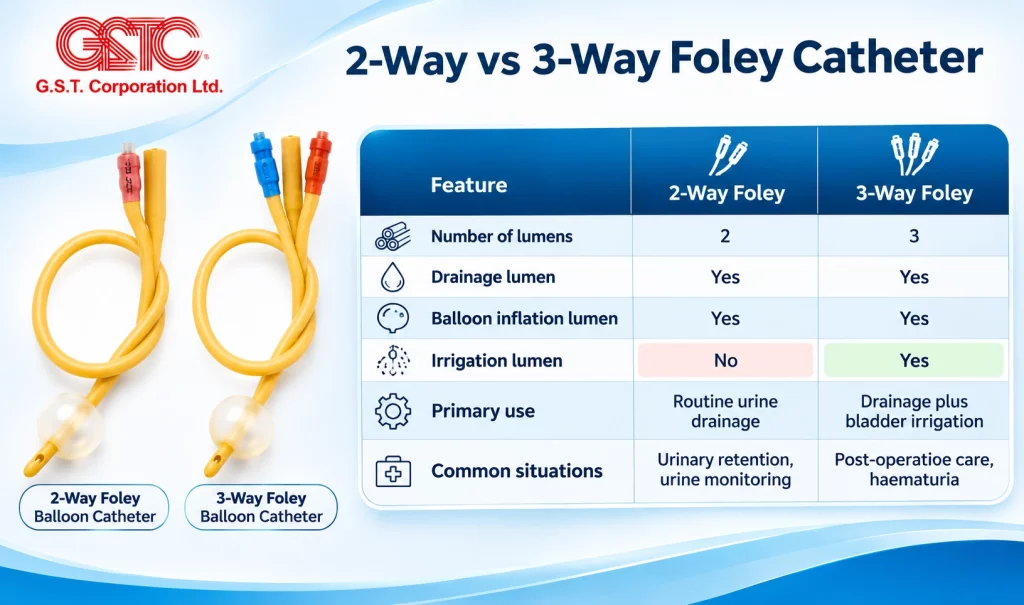
It comes down to the number of channels. A 2-way catheter has one channel for drainage and one for the balloon. A 3-way catheter adds a third channel, which is used for flushing the bladder with saline water.
| Feature | 2-Way Foley | 3-Way Foley |
|---|---|---|
| Number of lumens | 2 | 3 |
| Drainage lumen | Yes | Yes |
| Balloon inflation lumen | Yes | Yes |
| Irrigation lumen | No | Yes |
| Primary use | Routine urine drainage | Drainage plus bladder irrigation |
| Common situations | Urinary retention, urine monitoring | Post-operative care, haematuria |
For normal drainage, a 2-way catheter is used . While A 3-way catheter is chosen when the bladder needs continuous irrigation or cleaning, which results after a prostate surgery or when there is bleeding.
A few other variants worth knowing of Foley Balloon catheter
A curved or coude tip catheter has a slightly curved tip. In the cases of men with an enlarged prostate or a narrow urethra, a straight catheter is not suitable and can be hard to pass, in this case the curved tip helps.
A silicone Foley Balloon catheter is latex-free, which is a better option for people with latex allergy and for long time use.
A hydrophilic-coated catheter or hydrogel is used which turns the catheter slippery when it’s wet, so the friction is reduced and also the discomfort during insertion and removal.
Sizes and Colour Coding of Foley Balloon catheter
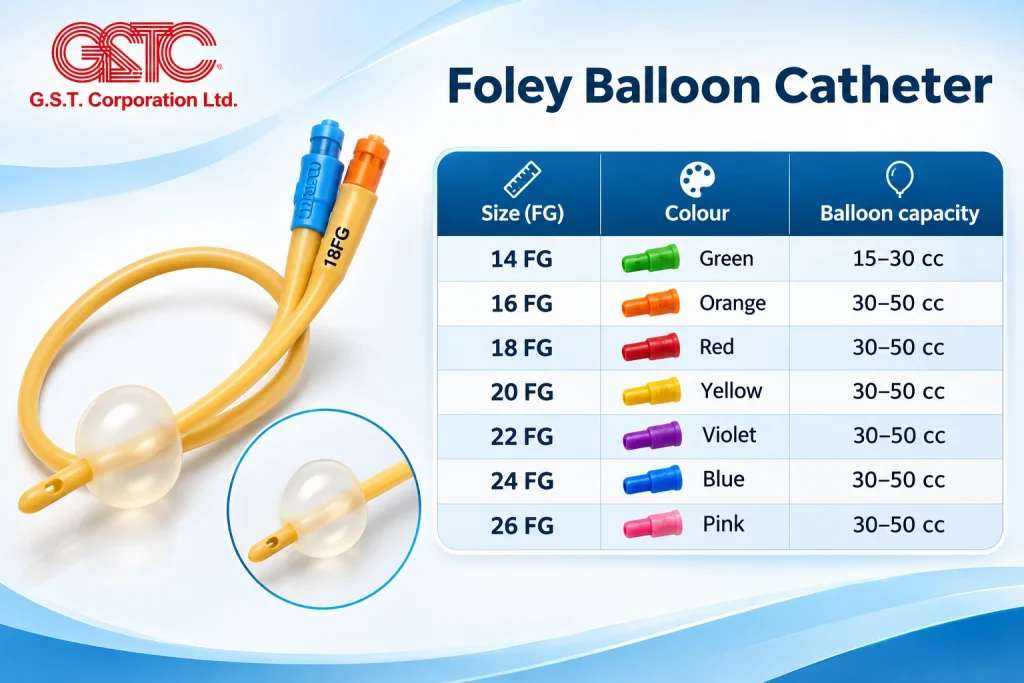
Foley catheter size is measured in FG. Each size has its own colour on the funnel, so medical professionals can pick the right one in seconds, even in a rush.
| Size (FG) | Colour | Balloon Capacity |
|---|---|---|
| 14 FG | Green | 15–30 cc |
| 16 FG | Orange | 30–50 cc |
| 18 FG | Red | 30–50 cc |
| 20 FG | Yellow | 30–50 cc |
| 22 FG | Violet | 30–50 cc |
| 24 FG | Blue | 30–50 cc |
| 26 FG | Pink | 30–50 cc |
Smaller sizes, such as 8–10 FG, are made for children. As a general rule, the smallest size that drains well is chosen, because it causes the least irritation to the urethra.
What Are the Benefits of Foley Balloon catheter?
The biggest benefit is simple: the patient’s bladder continuously gets drained without going to passing it off. This protects the kidneys and prevents the overfilling the bladder. Urine output is correctly measured, so that doctors can get a better understanding of their patients’ conditions. Patients who are immobile or have surgical wounds keep clean and dry thanks to the balloon that holds the Foley catheter firmly in place. Medication administration and bladder irrigation are also made possible with a three-way catheter.
How to Choose the Right Foley Balloon catheter
Don’t base your decision just on pricing if you are an importer, distributor, or from the hospital procurement team. Start with the material first, The safest choice is latex-free silicone, particularly for all patient including those who have allergy issues. Next, decide the design: two-way for regular drainage, three-way if irrigation is required.
On the recommendation of the team, select the size based on the patient’s age and anatomy as per the record of the hospital or requirement. Since the balloon and valve are the first components of the catheter to break in low quality materials, thoroughly inspect their quality. The manufacturer should be certified in WHO-GMP and ISO 13485, and the packaging should be sterile and untampered. Consistent quality and timely delivery. We at GSTC fulfill all the requirements of yours.
Why Choose GSTC Foley Balloon catheter?
GSTC has been manufacturing medical products since 1959 and exports to more than 60+ countries today. Our Foley balloon cathetes are made from 100% latex-free silicone, come in both 2-way and 3-way designs, and are manufactured under ISO 9001:2015, ISO 13485:2016 and WHO-GMP certifications. For More specific details visit our product page of Foley Balloon Catheter
Conclusion
A Foley balloon catheter may look simple, But in real life situation of critical care, post-operative & long-term care, it plays a very important role in patient care and recovery by helping the the bladder to get empty and also helps the medical team to accurately monitor urine output.
Selection includes its lumen design either 2-way or 3-way (for regular drainage, or when irrigation is needed), its material (in most cases latex-free silicone is the safest option to choose), the right size and tip for the patient, and a manufacturer you can trust for reliable quality.
Always remember that a catheter must only be inserted and removed by a qualified medical professional and removed as soon as it is no longer required. If you need reliable Foley balloon catheters in bulk, visit our Foley Balloon Catheter.