

What Is Safety IV Cannula
The IV line setup is the most common operation in any hospital. The doctor prepares the cannula. He locates the vein. He inserts it. He removes the needle and starts the treatment. All those processes are standard procedure. But there is a threat at the time when the needle is withdrawn from the vein. The patient’s blood is in a used needle and a single accidental puncture might expose a health care worker to bloodborne diseases like hepatitis B, hepatitis C and HIV/AIDS.
This is where Safety IV Cannula Comes in picture. A conventional IV cannula leaves the needle totally exposed after usage . Safe handling depends on the medical staff holding the needle. A safety IV cannula has the protection mechanism designed within the cannula. In most designs, the sharp tip is covered by a shield or retracting mechanism when the needle is removed from the catheter.
In this blog post, we’ll explain how a safety IV cannula is different from a traditional IV cannula, how the safety mechanism works and why more hospitals and clinics are choosing to use it to minimize needlestick injuries.
What is an IV Cannula?
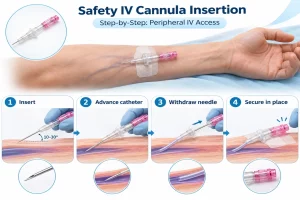
An IV Cannula is a small but essential piece of medical equipment that is put into a patient’s vein to deliver medications, fluids, blood products or nutrients directly into the bloodstream. It is constructed comprised of a catheter (a flexible, thin plastic tube) over a sharp metal needle. The needle help the healthcare professional to place the catheter into the vein. when the catheter is inserted correctly and the needle is then removed, result in leaving the catheter inside the vein, now the medications can be delivered without repeating the puncture of the vein.
IV Cannulas are mostly used in emergency departments of hospitals, clinics, ICU and even at home. From simple medication delivery to major surgeries, dialysis, chemotherapy and critical emergency treatment, the Safety IV cannula is fundamental to modern medicine. So its design, quality and safety mecahnisms are the key considerations.
 Traditional Cannula: Why It Needed to Change
The conventional cannula was a relatively simple design. Within the cannula there is a sharp metal needle inside a plastic tube. After entering the vein the needle was manually retracted . The tip remained fully exposed & aslo sharp after removal, until it’s disposed off . Meanwhile, the risk of unintentional injury was possible with every step of the process: the needle itself, the capping of the needle and the carriage to the disposal bin.
This is exactly why needlestick injuries (a nurse or doctor accidently getting hurt by the needle) were very common in hospitals. One tiny error could allow a healthcare worker to come into touch with a patient’s blood, and risk dangerous and life-changing illnesses, such as hepatitis B, hepatitis C and HIV. Every year, millions of needlestick injury cases are recorded across the globe. This is the very problem that has prompted the medical device sector to develop safer products.
Safety IV Cannula: The Solution
The direct solution to this issue is the safety IV cannula. Its ability to automatically retract and shield the needle right away after use is its biggest advantage. This means that the needle’s tip quickly gets cover within the safety shield after its removed from the vein, making it impossible to make any accidental injury to the healthcare professional. This small design change not only makes the procedure safer overall, but it also increases the safety of the healthcare professional while performing the procedure.
The Regulatory Journey Behind the Safety IV Cannula
The development of the Safety IV Cannula was inspired not only by medical innovation but also by an important history of healthcare worker safety:
- 1998 – California: California became the first U.S. state to introduce a law focused on protecting healthcare workers from needlestick injuries.
- 1980s – HIV/AIDS epidemic: The spread of HIV and other bloodborne infections increased awareness of the risks healthcare workers faced when handling blood and body fluids.
- November 6, 2000 – U.S. federal law: The Needlestick Safety and Prevention Act was signed into law. It encouraged the use of safer medical equipment and safer working practices.
- 62–88% of sharps injuries: CDC estimates showed that many sharps injuries could potentially be prevented by using appropriate safety devices.
- 600,000–800,000 needlestick injuries : This is the expected number of needle stick injuries U.S. healthcare professionals sustain each year.
- Millions of health care and allied personnel were exposed to occupational dangers from bloodborne infections.
- Frontline staff involvement: The regulations emphasised the need for input from non-managerial healthcare workers directly involved in patient care when evaluating and selecting safe devices.
- Security by Design: These developments helped establish an important principle in medical-device innovation: security must be built into the equipment itself, not solely dependent on user behaviour.
Traditional Cannula vs. Safety IV Cannula
| Aspect | Traditional Cannula | Safety IV Cannula |
|---|---|---|
| Needle Protection | No safety mechanism | Automatic needle retraction or shielding mechanism |
| Needlestick Risk | Higher | Significantly reduced |
| Handling | May require more manual handling | Designed for easier, safer activation and disposal |
| Infection Risk | Greater risk of accidental blood exposure | Reduced occupational exposure risk |
| Regulatory Acceptance | Conventional design | Increasingly preferred or required under sharps-safety regulations |
| Cost | Lower upfront cost | Higher initial cost, with potential savings from reduced needlestick injuries |
Key Features of the GSTC Safety IV Cannula
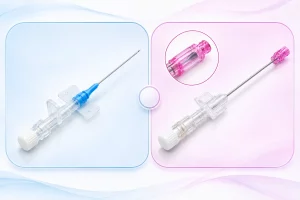
- Needle Shield that Self-Activates- As soon as the needle is removed, the protective chamber activates automatically, saving the nurse from having to take extra manual actions. Instant, passive protection when using an IV cannula at the highest danger.
- Colour-coded ISO 6009 Hubs- Nurses can quickly choose and verify gauge sizes thanks to internationally standardised colour-coded identification, which lowers selection errors during routine and emergency IV cannula insertion procedures.
- The Transparent Flashback Chamber-Immediate visible confirmation of successful venous placement is provided by a clear flashback chamber, which lowers the number of unsuccessful insertion attempts and increases first-attempt success rates for all patient age groups.
- Luer Lock Connection-Throughout active therapy, the twist-and-lock luer connection between the cannula hub and the IV infusion line prevents accidental disconnection during patient movement, repositioning, and ambulation.
- Adjustable Fixation Wings-For stable, sticky fixation in any hand or wrist position, the soft, flexible wings apply flat pressure to the patient’s skin, greatly reducing the risk of cannula displacement during prolonged IV therapy.
Types of Safety IV Cannulas
Safety IV cannulas come in a variety of configurations to satisfy various patient and clinical needs.
| Type | Description | Best Use |
|---|---|---|
| Standard Safety IV Cannula | Flexible catheter with self-activating needle shield | Routine ward-based IV therapy |
| Safety IV Cannula with Injection Port | Integrated port allows medication delivery without disconnecting the IV line | Multi-drug administration |
| Winged Safety IV Cannula | Flexible wings for stable skin fixation | Extended IV therapy; helps reduce displacement |
| Radiopaque Safety IV Cannula | Catheter visible under X-ray imaging | Complex cases requiring position confirmation |
| High-Flow Safety IV Cannula | Wider bore for rapid fluid delivery | Emergency resuscitation and trauma |
| Micro Safety IV Cannula | Ultra-fine gauge for delicate vascular access | Neonatal and paediatric patients |
GSTC uses both PUR (polyurethane) and FEP (fluorinated ethylene propylene) catheter materials to make Safety IV Cannulas; each offers unique clinical benefits suited to different patient care situations.
Safety IV Cannula Sizes—Gauge and Length
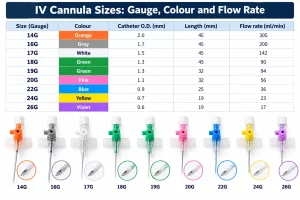
Gauge is used in reverse for sizing IV cannulas; the thinner the needle and catheter, the higher the gauge number. The patient’s vein size, the therapeutic application, and the necessary flow rate all play a role in choosing the appropriate gauge:
| Gauge | Colour Code | Flow Rate | Typical Clinical Use |
|---|---|---|---|
| 14G | Orange | 305 ml/min | Rapid fluid resuscitation, major trauma |
| 16G | Grey | 200 ml/min | Blood transfusion, surgical patients |
| 17G | White | 125 ml/min | General adult IV therapy |
| 18G | Green | 90 ml/min | Standard adult ward use |
| 20G | Pink | 55 ml/min | Standard adult use, chemotherapy |
| 22G | Blue | 36 ml/min | Elderly patients, difficult veins |
| 24G | Yellow | 22 ml/min | Pediatric patients |
| 26G | Violet | 17 ml/min | Neonatal patients and very fine veins |
A lower-gauge number cannula produces a higher flow rate. This is essential for emergency fluid resuscitation .A higher gauge number is advised for elderly, paediatric, and neonatal patients since it is less damaging to tiny or delicate veins.
The internationally known ISO 6009 color-coded hub system, which all GSTC Safety IV Cannulas adhere to, lowers selection errors in busy clinical environments by enabling nurses to rapidly determine gauge sizes without reading labels.
Why Choose a Safety IV Cannula?
Using a safety IV cannula has numerous strong advantages that benefit the entire healthcare system, not just one hospital:
- Reduced Needlestick Injuries: Healthcare professionals are protected from the infection risks, which is important for their personal and professional lives.
- Patient Safety: Safety IV Cannula helps in the exact and controlled supply of fluids and medications which helps to a higher level of care.
- Decreased Discomfort:Integrated injection ports ensure that patients don’t have to keep poking themselves with needles, making the process easier especially for the young and old.
- Legal and Regulatory Compliance Safety devices are now a legal requirement in many countries making it a compliance necessity.
- Employee confidence increased, employees are more focused on patient care and do not worry about their personal safety even during hectic hours.
- A modern, responsible option: Safety cannulas are now the norm, not an add-on, for any hospital that truly cares about its staff.
GSTC Reputable Safety IV Cannula Manufacturer and Exporter
With more than 60 years of experience in the medical device industry, GSTC manufactures Safety IV Cannulas under the Heuer brand in WHO-GMP and ISO 13485-certified facilities in India.
Key Features of the GSTC Safety IV Cannula:
- Gauge Range: 14G to 26G nine standard sizes with international colour coding.
- Catheter Material: PUR and FEP versions free of DEHP.
- Safety Mechanism: Needle protection that self-activates and locks without the need for human intervention.
- Hub System: Colour-coded identification that complies with ISO 6009 international standards.
- Connection: Secure, leak-proof IV line attachment with a Luer lock.
- Certifications: FDA-certified, ISO 13485:2016, WHO-GMP certified.
- Global Reach: Exported to more than 70 nations in Asia, Africa the Middle East, Europe and Latin America.
Conclusion
The most dangerous situation with a traditional cannula is just after insertion: when the needle is out, it’s still exposed and the healthcare professional is holding it. That’s where most needlestick injuries occur, and each one can mean exposure to hepatitis B, hepatitis C or HIV.
A safety IV cannula fills that gap. When the needle is pulled out, a built-in shield slides over it, so protection is not left to the person manually. That’s why hospitals that have made the switch to safety-engineered devices have seen lower rates of needlestick injuries, and why these cannulas have become the standard in so many facilities. At GSTC, we manufacture safety IV cannulas. The cannula does what it used to do. It also protects the professionals using it.