

What is Philadelphia Collar? Uses, Sizing, Limits & Comparison
A Philadelphia collar is a two-piece, semi-rigid cervical collar that limits neck movement, mainly forward and backward bending. It supports the chin and the base of the skull and has an opening at the front for tracheostomy care. It is commonly used after cervical spine surgery and for stable neck injuries
Most of them are constructed of a firm but flexible foam, often with plastic reinforcement at the stress points. The front shell has a built-in chin support and a large central opening. This is very common in post operative and intensive care settings, for this reason it gives access to the front of the neck for a tracheostomy, dressing changes or monitoring.
What is Philadelphia Collar?
A Philadelphia collar is a semi-rigid two-piece cervical orthosis collar which is used to restrict neck motion following injury or spine surgery. It is one of the most popular collars used in hospitals, trauma centers and orthopaedic centres. This blog explains how it is manufactured, when it is the right choice to pick, where it don’t be the right choice to use and what to consider when sourcing it for a hospital or clinics.
How Philadelphia collar works, and what it does not do
The collar function is to restrict the neck movement. The chin and occipital supports keep the head from tipping too far forward or back, and the closed ring assures how far the neck can move to & fro.
It is important to have accuracy in terms of movements. A Philadelphia collar restricts flexion and extension very well. It provides control of rotation and side bending but does not completely immobilise the cervical spine. Most of the clinical literature considers it to be a moderate-restriction device, stronger than a regular soft collar but weaker than a collar with thoracic extension or a halo vest.. That is why the choice should always follow the doctor’s assessment of the injury, not the other way round.
Common uses of Philadelphia Collar:
A clinician may prescribe a Philadelphia collar in situations such as:
- After cervical spine surgery – during the recovery phase following the spine surgery, philadelphia collar is used for early healing.
- Stable cervical injuries – Philadelphia collar is used when there is a certain fractures or ligament sprains, where moderate restriction is sufficient.
- Short-term stabilization during transfer or transport, until imaging and a definitive plan are in place.
- Selected cases of severe whiplash or cervical spondylosis, in this case philadelphia collar is used for a certain period of time where restricted movement is necessary.
- Patients with a tracheostomy or neck wound, where the open front panel allows access without removing the collar.
 When a Philadelphia collar is not enough?
The Philadelphia collar alone is typically not sufficient for unstable cervical fractures, substantial ligamentous disruption, or injuries in the upper or lower cervical segments, for which more rigid options like a cervicothoracic orthosis, a halo vest, or surgical fixation might be necessary.
It also does not treat ordinary neck pain. If a collar is used for a long time when it should not be used, the neck muscles can get weaker and recovery can take longer. If someone has neck pain following a fall, road accident or sports injury, they should be seen by a doctor before anything is put on.
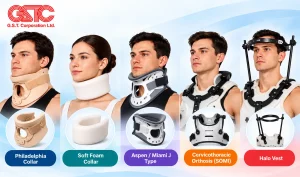
Philadelphia collar vs other cervical collars
| Feature | Soft Foam Collar | GSTC Philadelphia Collar | Aspen / Miami J Type | Cervicothoracic Orthosis (SOMI) | Halo Vest |
|---|---|---|---|---|---|
| Level of Restriction | Minimal, mostly a reminder to limit movement | Moderate | Moderate to high | High | Highest |
| Typical Setting | Mild strain, short-term comfort | Post-op, stable injuries, transport | Trauma, post-op, longer-term use | Upper and mid-cervical injuries | Unstable fractures |
| Adjustability | Limited | Size-based, some adjustable models | Adjustable height | Fitted | Surgically applied |
| Access for Tracheostomy or Wound Care | No | Yes, via front opening | Yes, on most models | Limited | Limited |
| Skin-Pressure Risk | Low | Moderate | Lower with good padding | Moderate | Pin-site care needed |
The practical takeaway is that the Philadelphia collar sits in the middle. It is simple, economical and familiar to clinical staff, which makes it a workhorse, but it is not the answer to every cervical injury.
Sizing and fitting
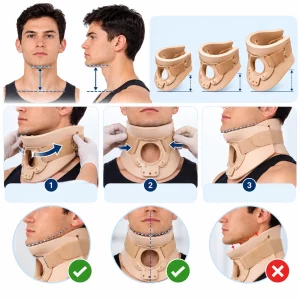
A Philadelphia collar that doesn’t fit well is not only uncomfortable, it also doesn’t do its job. Too short and the chin is not supported so the head can still flex . Too tall and it makes the head extend and creates pressure under the chin and jaw.
Sizing is generally based on two measurements, the distance from the top of the shoulder to the bottom of the chin, and the neck circumference. Manufacturers have their own sizing charts, so make sure to follow the chart for that particular product. A simple test of the fit:
- The head should be neutral, looking straight ahead, not tilted up or down.
- The chin should rest on the chin rest, not hang over it.
- The collar should be tight, but you should be able to slide one finger under the edge.
- The front apex should be positioned centrally above the throat.
- The jaw, collarbone and back of the head should be free of pressure.
Fitting should be done by, or checked by, a trained clinician or nurse, especially for post-operative and trauma patients.
Wearing and caring for the collar
The duration of wearing a collar and whether it can be removed for hygiene is decided by the medical professional and also depends on the diagnosis, so it should never be guessed from a general thought. We can do the following instead
- Check the skin daily: you can check the skin particularly under the chin, jaw area and at the back of the head. If there is any redness that does not fade is an early sign for the pressure.
- Keep the collar pads clean and dry: If there is any moisture in the pads of the collar are the common cause of irritation. Most of the collars come with extra replaceable pads to rectify this reason.
- Follow the doctor’s guidelines on removal: There are some cases in which the collar must not be taken off at all without supervision of the medical professionals.
- Report new symptoms promptly: IF there is an increase in pain, sometimes numbness or tingling in the arms, dizziness, or difficulty swallowing or breathing then it should be take off only after doctor consultation & supervision.
Risks and limitations
Even when correctly prescribed, a collar has downsides that are worth stating plainly:
- Pressure sores, especially on the chin, jaw, and occiput in patients with poor skin conditions or who are immobilised.
- Patients may loosen or remove it due to discomfort and a sensation of heat.
- There is some difficulty swallowing and a sense of limitation.
- Stiffness and weakness of the muscles if worn for extended periods of time.
- A delusion of security. Although it limits movement, it does not prevent major injuries.
One caution that is easy to miss: a collar that is fitted too tightly, or worn for longer period of time , can cause compression of the veins in the neck and may increase the pressure inside the skull of the human. This is another reason why the proper fit and the wearing time should be set by a medical professional, and why the adjustment of the collar should only be done by the healthcare professional.
What to check when sourcing Philadelphia collars (for hospitals, clinics and distributors)
For institutional buyers, the differences between two collars that look alike can be significant. Questions worth asking any supplier: We at GSTC ensures that our Philadelphia collar fullfill all the requirements.
- Material and construction. Is the foam used is enough to hold its shape and is soft enough to be tolerated? Does the reinforced placed is at the right points?
- Size range. Is the collar range covers paediatric through large adult sizes, and whether the manufacturer has published size chart?
- Pads and hygiene. Are Pads replaceable? Can the surface of the collar be wiped down between patients where reuse is intended?
- Radiolucency. Will the collar allow imaging without being removed? This is an important aspect in trauma and post-operative follow-up.
- Fastening. Is the closure secure, easy to put on and easy to adjust single handedly?
- Certification and traceability. Ask for the appropriate quality management and regulatory documentation for your market and batch traceability.
- Packaging and labelling. Assure that size markings are Clear,also individually packed units and instructions for use, all this reduces errors in the ward.
- Supply reliability. If you reorder regularly, the unit price matters less than having consistent specifications from batch to batch.
Sourcing from GSTC
GSTC manufactures a two-piece Philadelphia collar in medical-grade EVA foam with a tracheostomy opening, produced under ISO 9001:2015 and ISO 13485:2016 quality systems. Full specifications, the size chart and export terms are on the Philadelphia collar product page.
Final thoughts
The Philadelphia collar remains a life saving collar because it is simple, familiar and suited to a wide range of stable injuries and post-operative needs. Its value depends on three things selecting the right patient, right size and fit, and clear medical guidance.” When you are sourcing for a hospital, clinic or distribution network, quality-checked, well-sized and well-documented product is more important than the lowest price
To see our range of cervical collars and orthopedic supports, visit us. For specifications, size charts or export enquiries.
This article is for general information only and is not medical advice. A cervical collar should be selected, fitted and used under the guidance of a qualified healthcare professional.