

Epidural Needle: What is an epidural needle, How It Works, Types, Sizes:
An epidural needle manufactured by GSTC is a hollow, wide-bore needle that helps an anesthesiologist to reach the epidural space(a narrow space just outside the membrane surrounds the spinal cord). The needle itself doesn’t help in the pain relief. But its job is different: it opens a safe way so a thin catheter can be placed exactly in the epidural space, and then the drugs can be administered through that catheter. The design of the needle is to stop at the edge of the dura and not go through it. You can see the epidural needle manufactured by GSTC on our product page.
It is used in the following
- Labor pain relief
- Surgical anesthesia
- Post-operative pain control
- Chronic back pain treatment.
Pain control after major surgery and childbirth is one of the main goals of modern medicine, and this small device sits at the center of it. This guide walks through each of those choices, what they mean in practice, and what to look for if you source, or import epidural needles.
When is an epidural needle used?
An epidural is chosen when pain relief is the key aspect for any operation, or during the child birth, these are the following scenario where the epidural needle is used.
| Situation | Why an Epidural Is Used |
|---|---|
| Labor and delivery | Helps reduce pain from uterine contractions and childbirth while allowing the mother to remain awake and alert during labor. |
| Surgery | Provides regional anesthesia and pain relief for lower abdominal, pelvic, and lower-limb procedures. It may also be used in combination with general anesthesia. |
| After surgery | An epidural catheter can remain in place to continuously or intermittently deliver pain-relieving medication, helping improve comfort during postoperative recovery. |
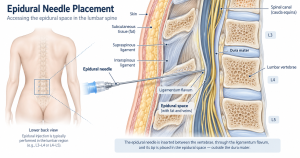
If you are still wonder what is an epidural needle in practical terms, it is the device that makes each of these situations mentioned above possible.
Types of Epidural, and how the needle is used:
GSTC manufactured needles have two types of techniques used in the medical world, as follows:
Epidural anesthesia or analgesia It’s used to give local anesthesia in the epidural space in order to block pain signals along the spinal nerves. The effect is for a short duration and depends on the dose.
Epidural steroid injection (ESI) places a corticosteroid near affected nerve roots, to decrease the inflammation and pressure. It doesn’t numb the area in the same way as the anesthesia did. And it is for continued pain , not a procedure.
The medication can be delivered in several ways:
| Technique | How It Works | Typical Use |
|---|---|---|
| Single injection | A single dose of medication is injected into the epidural space, after which the needle is removed. | Steroid injections and selected short-duration procedures |
| Catheter technique | A thin catheter is passed through the epidural needle and left in place, allowing repeated or continuous administration of medication. | Labor pain relief and longer surgical procedures |
| Patient-controlled epidural analgesia (PCEA) | An epidural catheter remains in place, and the patient can administer additional pre-set, controlled doses using a handheld device, usually alongside a continuous infusion. | Labor analgesia and post-operative pain management |
| Combined spinal-epidural (CSE) | A spinal needle is passed through the epidural needle to deliver a rapid-acting spinal dose. An epidural catheter is then placed for continued or additional medication as required. | Labor analgesia and selected surgical procedures |
Epidural needle design is due to its catheter techniques. A needle for one injection could be much easier, while a catheter needle must allow a catheter to slide through it without catching. So at GSTC during the designing phase all these parameters are taken into consideration & proper quality inspection is done before the needle actually rolls out in the market.
What Is an Epidural Needle, and How Is It Different from a Regular Needle?
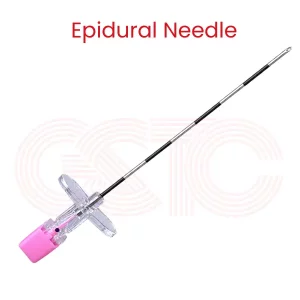
An epidural needle is little thicker than a standard injection needle, it has a curved, blunt tip, and carries a stylet inside the shaft. These features let the anesthesiologist reach the epidural space without puncturing the duramater and pass a catheter through it to introduce medicine.
How the needle is designed to be safe
The epidural space is accessed by travelling through the skin, ligaments, and ultimately the ligamentum flavum, a tough band immediately adjacent to the space. The anaesthesiologist knows he has gotten into the epidural space because he feels a change in resistance as the tip crosses that ligament . In adults, the distance is usually somewhere between 4 and 6 cm, but it varies from person to person. Needles manufactured by GSTC have this sensitivity that anesthesiologists can easily identify through the movement of the needle.
That is the reason for the two design features of the standard needle:
- A curved, blunt tip (the Tuohy design). The Epidural needle was invented in the 1940’s. The blunt curve tends to push tissue aside rather than cutting through it reducing the chance of puncturing the dura and angles the catheter along the space.
- Depth markings and a clear hub. You can keep track of depth with centimetre markings on an Epidural needle about 9 cm long, and a clear hub makes it easy to see fluid or air.
If the dura is accidentally punctured, cerebrospinal fluid can leak, which results in a headache that is commonly worse when upright. Since the epidural needle are large, the tip or the hole of the needle is bigger as compared to spinal needle, so tip design and finish is of great importance.
Epidural needle sizes: gauge and length
Gauge works backward, the higher the number the thinner the needle. Catheter techniques usually employ a 17- or 18-gauge needle, as it will allow passage of a 19- or 20-gauge catheter.
| Gauge | Approx. Outer Diameter | Typical Role |
|---|---|---|
| 16G | 1.65 mm | Larger-bore epidural needle, used when a larger catheter or greater needle rigidity is preferred. |
| 17G | 1.47 mm | Common adult epidural needle, often used with a 19G epidural catheter. |
| 18G | 1.27 mm | Common adult epidural needle, often used with a 20G epidural catheter. |
| 19G–20G | 0.90–1.07 mm | Smaller-diameter needles that may be selected for paediatric or other situations where a smaller needle is preferred. |
Its very common to understand that a thicker Epidural needle provides better to & forth motion and easier catheter flow but leaves a wider hole if the dura is punctured accidentally. Whereas a thinner needle is softer but may not be as reliable in accessing the area in the spinal cord which can be risky. One study found that placement was confirmed in 92% of patients: 20G Tuohy needles used for epidural steroid injections, as compared to roughly 99% for normal 17 or 18 gauge needles.
Adult needles are typically 9 to 10 cm long, with larger needles for patients who have deeper spaces and shorter needles for minors. Gauge and length are always at the clinician’s discretion.
Types of Epidural needles
| Type | Tip Design | Typical Use / Application |
|---|---|---|
| Tuohy | Curved, blunt, bevelled tip | Most commonly used for epidural catheter placement. The curved tip helps guide the catheter into the epidural space. |
| Hustead | Curved tip with a gentler curve than a Tuohy needle | Used for epidural catheter placement, where controlled catheter direction is required. |
| Crawford | Straight needle with an angled bevel | More commonly associated with single-shot epidural injections rather than catheter techniques. |
| Weiss | Tuohy-style curved tip with wings | Provides additional grip and control during epidural needle insertion and catheter placement. |
| Needle-through-needle (CSE) | Epidural needle used together with a longer, fine spinal needle | Used for combined spinal-epidural (CSE) procedures, providing rapid spinal anesthesia followed by continued epidural analgesia or anesthesia. |
 What patients can expect
The following is general information. Your care team will give you specific instructions.
Before. Patients may be asked to be on fasting for approx 6 hours, and also in old age to temporarily stop certain medicines like blood thinners.
During. First the skin is numbed. This typically feels like a quick pinch. Some people feel pressure or a twinge, some feel nothing when the needle is inserted. Report any severe, sharp pain immediately.
Onset and duration. It usually takes 20 to 30 minutes for an epidural anaesthesia to work. Steroid injections can take a few days to start working and can relieve pain for a few months. The numbness from one shot of the anaesthesia usually disappears off within a few hours and with a catheter, the numbness will reduce after few hours after your last dose.
Afterwards. Avoid driving, operating machinery, and alcohol for at least 24 hours.
Safety, risks and a common myth
Epidurals are common and usually safe when performed by trained anaesthesiologists or pain specialists. Complications are rare, but can occur, such as:
- Bleeding or infection at the site of injection
- Rare: Cerebrospinal fluid leak with a positional headache
- Nerve damage (rare)
- Medicine reaction
The back pain myth: Many people think that an epidural leads to chronic back pain. Long term back problems from an epidural are very rare. Mild tenderness at the site of injection for a few days is common. Whether or not a woman had an epidural during childbirth, back pain is common after childbirth as the pelvis and ligaments are readjusting.
When to seek medical help after an epidural: if you have fever or loss of bowel or bladder control, Numbness or weakness in the legs that lasts longer than expected, Severe headache that gets better when you lie down
Where needle quality matters
Technique is the most important factor but the equipment can make it easier or harder:
- A burred or damaged tip – If the tip is burred or damaged it will hook or blunt on bone.
- A rough inner bore A rough internal bore can hold the catheter.
- A stylet that seats badly A poorly positioned stylet may allow tissue to block the needle.
- The loss-of-resistance syringe a loose hub.
- A weak shaft – If the needle’s shaft is weak then it can bend, especially at finer gauges.
A buyer’s checklist
If you’re evaluating a supplier, test samples yourself and don’t rely only on the datasheet.
| Check | What to Look For |
|---|---|
| Tip finish | Smooth, well-finished bevel under magnification, with no burrs, sharp irregularities, or surface defects, and a consistent tip curvature. |
| Catheter passage | The corresponding epidural catheter should pass smoothly through the needle without excessive resistance, snagging, or damage. |
| Stylet | Stylet should be fully seated, securely fitted, and flush with the needle tip/orifice when inserted. |
| Hub | Hub should be transparent for visibility, securely bonded to the needle, compatible with the intended connection, and provide comfortable wings/grip where applicable. |
| Markings | Depth markings should be clear, legible, permanent, and evenly spaced, typically in centimetre increments. |
Standards worth knowing
Epidural needles manufactured by GSTC are ISO 13485:2016 and ISO 9001:2015 certified and individually sterile packed. Our Epidural Needles are available in private-label or OEM packaging, and we also provide batch-level documentation, which makes identification transparent . We have been exporting for the last 6 decades to more than 60+ countries worldwide, so we have a vast network and quick delivery channels that help ensure every shipment arrives on time and in good condition.
The certificate numbers and validity dates are on your certificates page, so you can link “ISO 13485:2016 and ISO 9001:2015 certified” to it: https://www.gstc.com/about-us/certificates/
- ISO 13485 covers the manufacturer’s quality management system.
- ISO 9626 covers stainless steel needle tubing.
- ISO 11135 covers ethylene oxide sterilization, and ISO 10993 covers biological evaluation.
- ISO 80369-6 (NRFit) covers neuraxial connectors, designed to prevent wrong-route medication errors. Adoption varies by region, so check what your market requires.
Questions to ask a manufacturer
- What are your current certificate numbers and validity dates?
- What is your exact gauge and length range, and which catheters do you recommend?
- How do you sterilize, and what residual limits apply?
- Can you provide batch-level documentation?
- Do you offer OEM or private-label packaging?
- What are your MOQ and export lead times?
At GSTC we manufacture and export a Tuohy-tip epidural needle with EO sterilization, individually packed sterile pouches, and OEM and private-label options.
So, what is an epidural needle? It is the precision tool behind safe, controlled epidural pain relief, and its design and quality matter more than most people realize.